2N3904 Project • Dec 25, 2025 • Authored by Steve Morrison, BS, Electrical Engineering Technology, MBA
Light an LED With Your Finger (2N3904 Darlington Pair)
A simple experiment showing how two 2N3904 transistors wired as a Darlington pair can amplify the tiny current from a human finger to light an LED from a 9-volt battery.
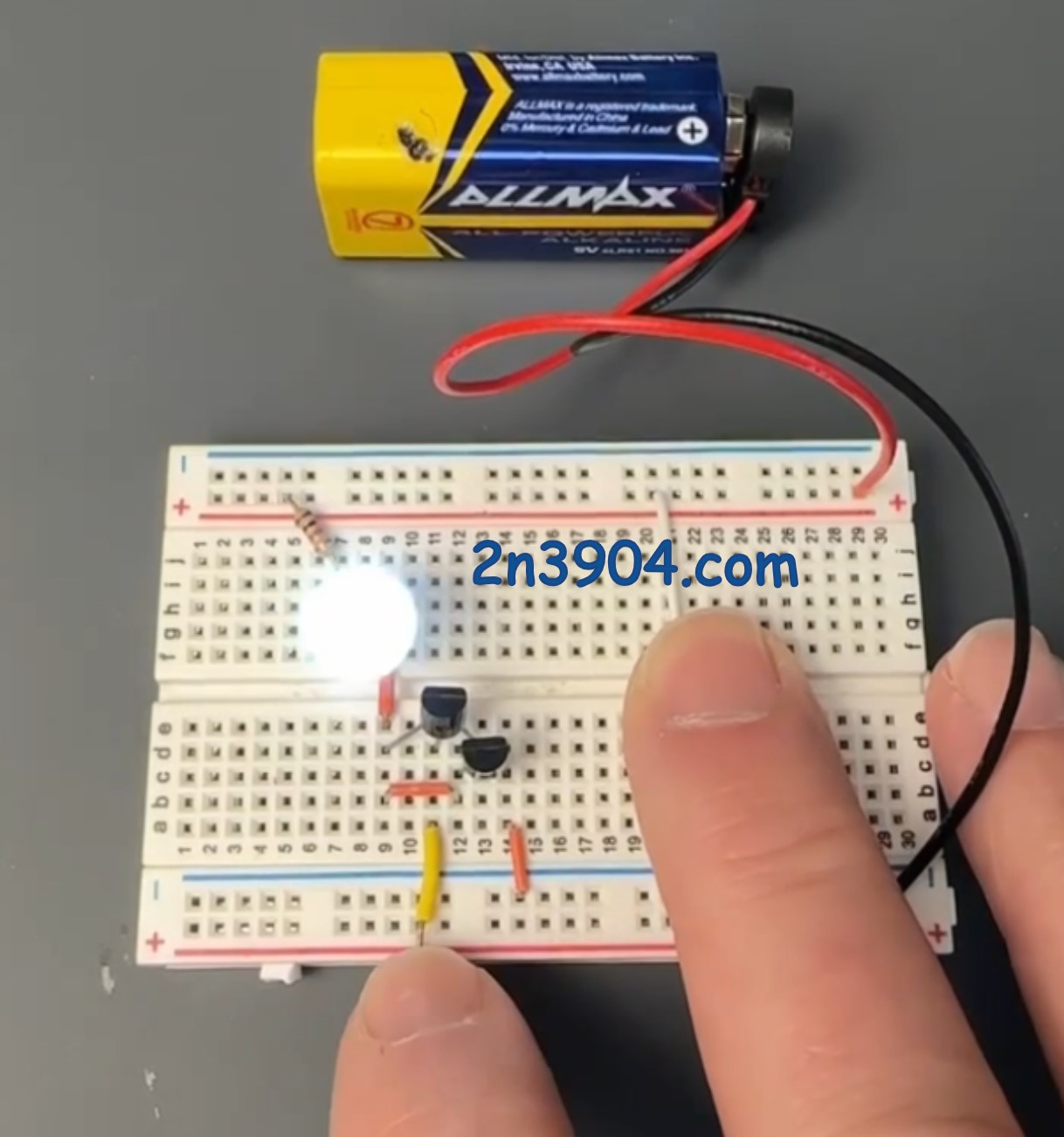
Finger touching the base of Q1 while the LED lights:
Introduction
Can the tiny amount of electricity that leaks through your skin actually do something useful?
At first glance, it seems impossible. Your body has a resistance measured in tens or even hundreds of thousands of ohms, sometimes more. The current involved is microscopic. On its own, it’s nowhere near enough to power anything meaningful.
But this is where transistors shine.
In this project, you’ll light an LED using nothing more than your finger — not by shocking yourself, and not by powering the LED directly, but by using your body as a very weak signal source. That tiny signal gets handed off to a transistor, which then asks the power supply to do the real work.
We’ll start by seeing why a single 2N3904 transistor isn’t quite enough. Even with a respectable DC current gain of around 100–150, the finger current is simply too small to reliably drive an LED from a 9 V battery.
So we add a second transistor.
By wiring two 2N3904 transistors in a Darlington pair, we multiply their gains together, ending up with an effective current gain on the order of ~20,000. That’s enough amplification that a barely measurable finger current becomes real LED current.
The result feels like a magic trick — touch the circuit, the LED lights — but it’s really just transistor physics doing exactly what it’s supposed to do.
What You’ll Build
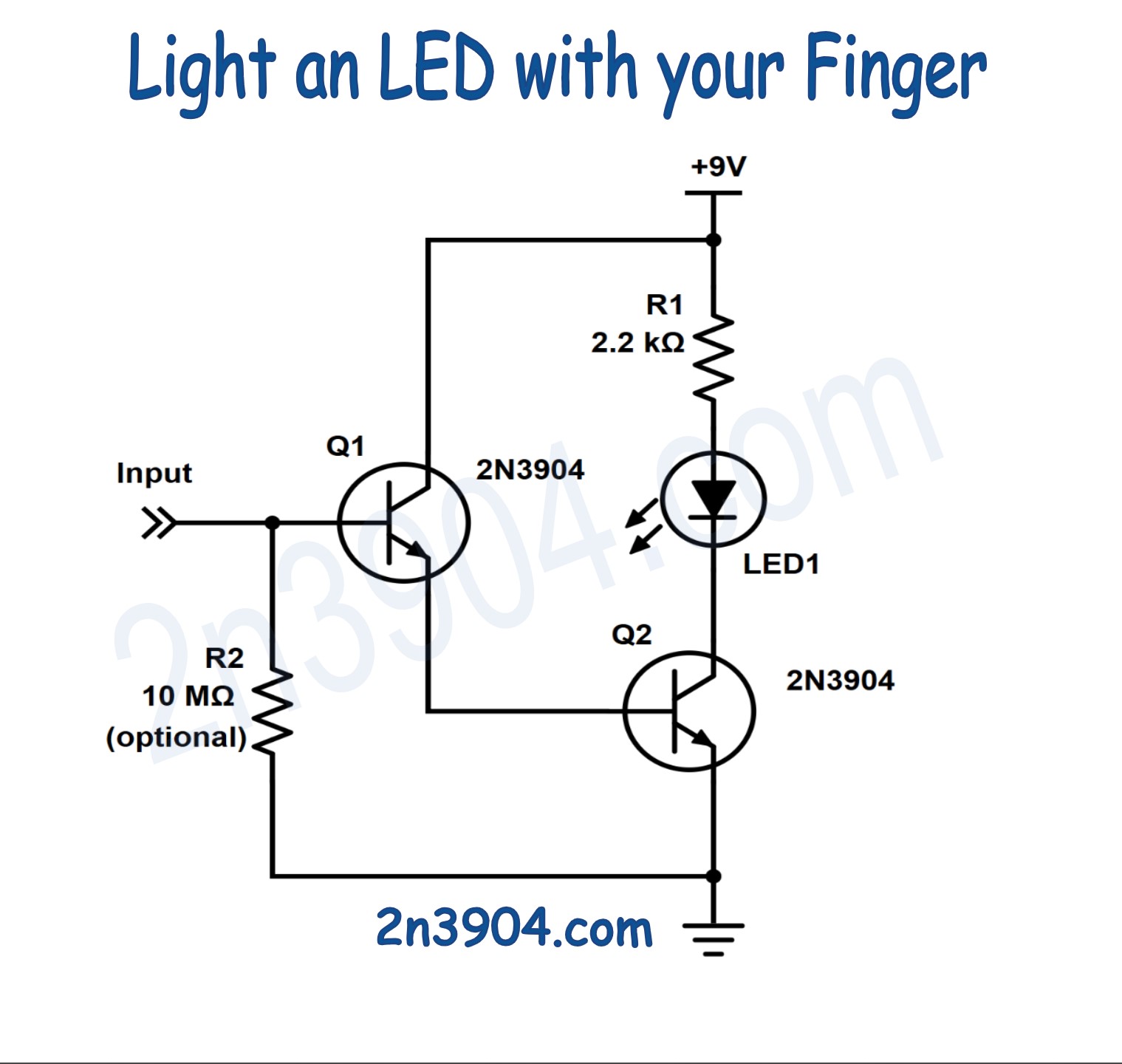
You’ll build a simple low-side switching circuit using a Darlington pair made from two 2N3904 NPN transistors. The LED is powered from a 9 V battery, and your finger provides the tiny base current needed to turn the transistors on.
One finger touches the positive rail, the other touches the base of Q1, and your body becomes part of the circuit.
Parts Needed
- (2) 2N3904 NPN transistors
- (1) LED (any standard 3 mm or 5 mm LED)
- (1) LED current-limiting resistor: 2.2 kΩ (for 9 V)
- (1) Base pull-down resistor: 1 MΩ to 10 MΩ (optional)
- Breadboard and jumper wires
- 9 V battery and battery clip
Using higher resistor values keeps the LED current low and makes the circuit more sensitive to the very small base currents coming from your finger.
Why One Transistor Isn’t Enough
A single 2N3904 typically has a DC current gain somewhere around 100 to 150, depending on operating conditions.
Let’s assume your finger manages to leak about 1 µA of base current into the transistor.
That gives:
1 µA × 150 = 150 µA of collector current
At 9 V, that’s usually not enough current to produce a visible LED glow through a resistor. You might see a faint flicker under ideal conditions, but it won’t be reliable.
This is an important takeaway: high gain doesn’t help much if the input signal is extremely weak — unless you multiply the gain again.
Enter the Darlington Pair
A Darlington pair is simply two transistors connected so that the emitter of the first transistor feeds the base of the second.
- Emitter of Q1 → Base of Q2
- Collectors of Q1 and Q2 tied together
- Emitter of Q2 connected to ground
Because the gains multiply, the effective gain becomes:
βtotal ≈ β1 × β2
For two transistors each with a gain of around 150, the combined gain is roughly 20,000.
Now that same 1 µA finger current can turn into tens of milliamps of collector current — easily enough to light an LED from a 9 V battery.
Your finger is no longer trying to power the LED. It’s simply telling the transistors to turn on.
Wiring the Circuit
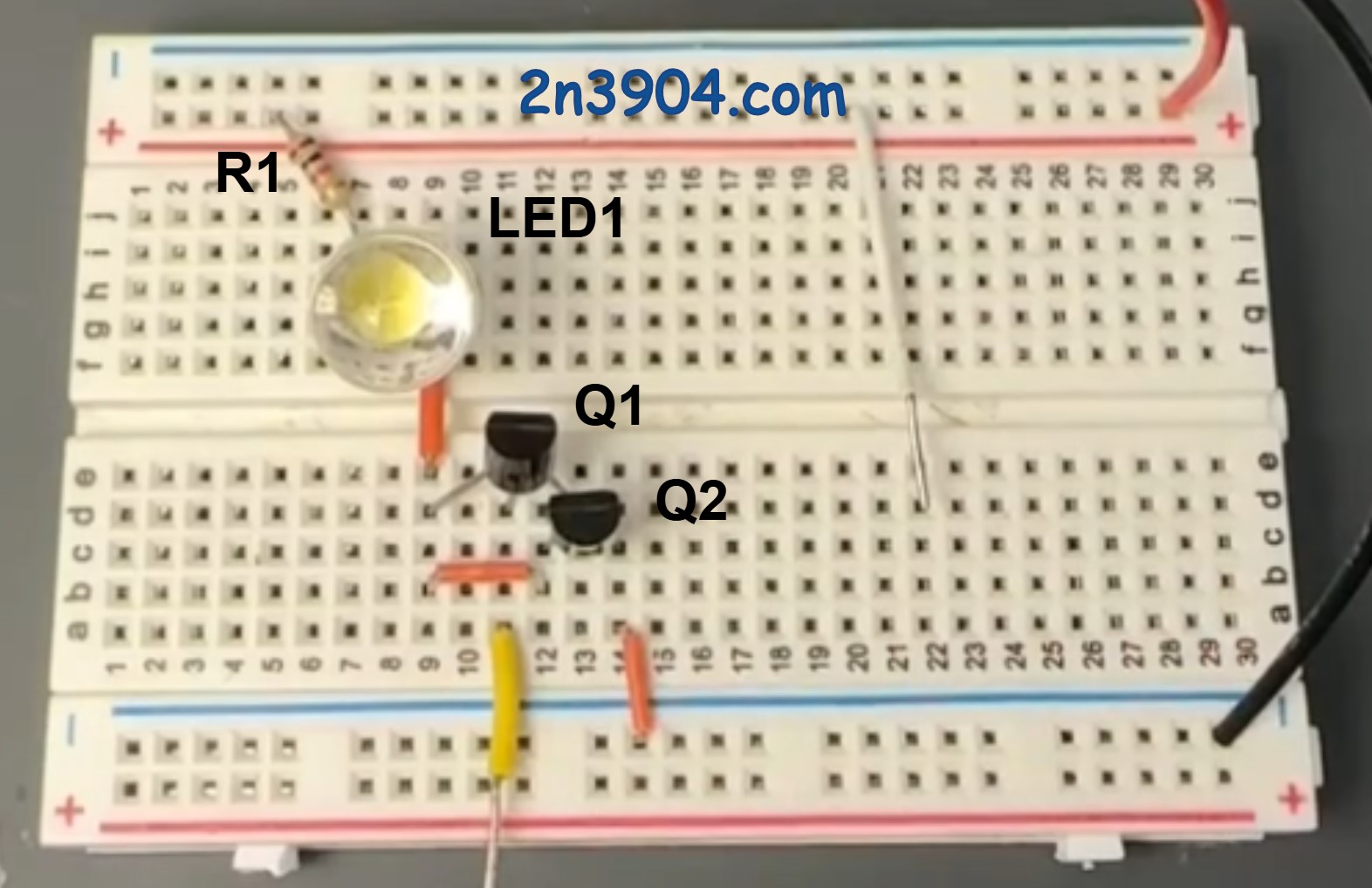
- Place both 2N3904 transistors on the breadboard and verify the pin orientation.
- Connect the emitter of Q1 directly to the base of Q2.
- Tie the collectors of Q1 and Q2 together.
- Connect the emitter of Q2 to the ground (negative) rail.
-
Wire the LED path:
- +9 V → resistor → LED → collector node
- Optional - Connect a large pull-down resistor from the base of Q1 to ground. This may be needed if the LED lights by default, as may be the case if the circuit is used in electrical noisy conditions. For demonstration purposes, it likely isn't needed.
-
Touch operation:
- One finger on +9 V
- One finger on the base of Q1
When everything is wired correctly, touching the base of Q1 while also touching the positive rail will cause the LED to light.
Final Schematic
Final schematic – 9 V finger-activated Darlington LED circuit:
Breadboard Image
Breadboard close-up showing Darlington wiring:
What’s Really Happening Electrically
Your body forms a very high-value resistance between the 9 V rail and the base of Q1. The resulting current is tiny, but it’s enough to slightly forward-bias the base-emitter junction of Q1.
That small current turns Q1 on just enough to feed base current into Q2, which then turns on much harder. Q2 allows current to flow from the LED to ground, completing the circuit.
All of the power for the LED comes from the 9 V battery. Your finger simply controls whether that power is allowed to flow.
Troubleshooting
-
LED doesn’t light
- Try a lower LED resistor (for example, 1 kΩ instead of 3.3 kΩ)
- Double-check transistor pinouts
- Slightly moistening your fingertip can help
-
LED stays on
- Increase the base pull-down resistor value
- Keep base wiring short to reduce noise pickup
-
Very faint glow
- Normal for very high resistance input paths
Safety Note
This experiment uses a 9 V battery, which is considered low-voltage and safe to touch. Never try finger-based experiments on anything connected to mains voltage or higher-energy sources.
Summary
Two 2N3904 transistors are wired as a Darlington pair to amplify the tiny current from a human finger, allowing a 9-volt powered LED to turn on. This project demonstrates extreme current gain, Darlington pair operation, and how transistors control power rather than supply it.